Friday, July 17, 2015

Istanbul - Day 1

The Basilica Cistern, a subterranean reservoir, built in the 6th century, provided a water filtration system for the Great Palace of Constantinople and other buildings on the First Hill, and continued to provide water to the Topkapi Palace after the Ottoman Conquest in 1453 and into modern times.
Model of how the cistern looks

The cistern, built by 7,000 slaves during Emperor Justinian's reign, is 143m long and 64m wide and used 336 marble columns. It is capable of holding 80,000 cubic meters of water, although it's largely empty today.
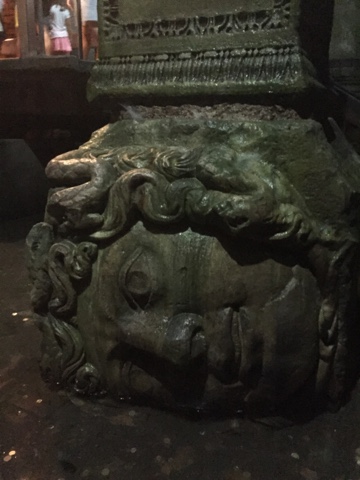
There are two stone Medusas located in the northeast corner of the cistern. This one is installed sideways, the other upside down. Nobody knows why but they do agree it was deliberate.

The Grand Bazaar apparently has over 4,000 stalls selling everything from clothing, to jewelry, to Turkish delight.


Istanbul - Day 2

Bosphorus Bridge: Europe on one side, Asia on the other
View back towards Istanbul from the Bosphorus Bridge
Bosphorus Bridge from the Asian side
Palace on the Asian side of the Bosphorus
Originally these were townhouses for palace personnel but they are now restored and used as upmarket shops
Turkey is densely populated
The Valens Aqueduct is a Roman aqueduct which was the major water-providing system completed by the Romen Emperor Valens in the late 4th century AD. It was maintained and used by the Byzantines and later the Ottomans, however today it doesn't appear to be an important landmark due to lack of maintenance.

I visited towards the end of Ramadan which is marked by a big feast the next day, Friday, normally the sabbath. Accordingly everyone was at the markets buying up big on all sorts of things.
Yes that's meat hanging unrefrigerated in 29c heat
Clearly 'something' was funny...

Thursday, July 16, 2015

Istanbul - First impressions

I really hadn't expected to find Istanbul to be a modern city with good roads populated with modern cars, lots of trees and gardens, contemporary office buildings and shopping centres. Nor was I expecting it to have between 20 and 23 million people. That's Shaghai numbers! Apparently there are many millions of unrecorded residents and refugees but flying over it you can see the population 'heft' evidenced by multiple residential towers in the outer suburbs.

It reminds me of Athens' old town, Plaka. Ancient ruins dotted through the cobblestone streets, and the hawkers standing outside restaurants. But tourism is very important to Turkey so the people are friendly.

The ruins here are the original wall to protect the palace from intruders approaching from the sea.

I went for a walk along the coast and was surprised to come across a community of afternoon sun worshipper (mostly old blokes) so who sunbake their leathery over brown skin.
As you can see it's not sand but giant granite boulders. It's do clearly a regular hangout that some bring concrete along to fashion a smoother place to lie down.
Whereas others don't seem to care
There's also a number of stray cats and dogs living amongst the rocks.
'It's a dog's life'

Tuesday, July 14, 2015

Stonehenge

The Stonehenge temple is perhaps the most famous prehistoric monument in the world dating back 4,500 years. It's a masterpiece of engineering with the stones arranged to line up with the movements of the sun.

The ruins as they are today are the end result of many different stages of construction, which started in the Neolithic Age around 2500 BC and ceased in the early Bronze Age. About 1,000 years prior to the current stones being placed, the Stonehenge Cursus (Latin for racetrack), a rectangular earthwork enclosure was created, although nobody has figured out why yet but it's probably ceremonial.

Two types of stone are used at Stonehenge – the larger sarsens and the smaller ‘bluestones’. The sarsens were erected in two concentric arrangements – an inner horseshoe and an outer circle – and the bluestones were set up between them in a double arc.


What's a henge? It's where tribes in times past buried their cremated dead.

Stonehenge as it probably was.

But the current stones aren't the first installation, as the earliest structures known in the immediate area are four or five pits, three of which appear to have held large pine ‘totem-pole like’ posts erected in the Mesolithic period, between 8500 and 7000 BC. However it's not known how these posts relate to the later monument of Stonehenge.