Thursday, November 6, 2014

The Willard


The Willard Hotel was formally founded by Henry Willard when he leased six buildings in 1847, combined them into a single structure, and enlarged it into a four-story hotel renamed the Willard Hotel. 

The present 12-story structure, designed by famed hotel architect Henry Janeway Hardenbergh, opened in 1901. It suffered a major fire in 1922 which caused $250,000 (which would be $3.5m in 2014) money. 

The Willard family sold its share of the hotel in 1946, and due to mismanagement and the severe decline of the area, the hotel closed in 1968. The building sat vacant for years, and numerous plans were floated for its demolition. It eventually fell into a semi-public receivership and was sold to the Pennsylvania Avenue Development Corporation. They held a competition to rehabilitate the property and ultimately awarded it to the Oliver Carr Company and Golding Associates. The two partners then brought in the InterContinental Hotels Group to be a part owner and operator of the hotel. The Willard was subsequently restored to its turn-of-the-century elegance. The hotel was re-opened on August 20, 1986. In the late 1990s, the hotel once again underwent significant restoration.

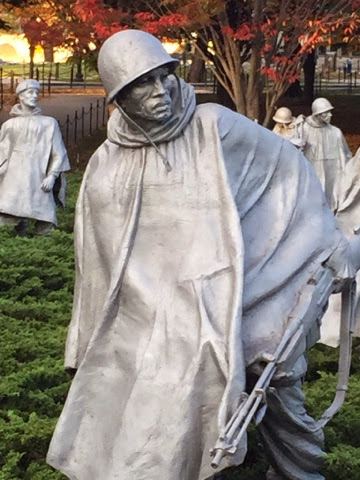
Washington - Tuesday

Another walk, another bunch of pictures.

Lincoln Memorial
Vietnam War Memorial
DuPont Circle
Statue of George Washington in Georgetown
Mural on the side of an apartment block
Old Wells Fargo mail delivery coach


Monday, November 3, 2014

Smithsonian National Air and Space Museum - Udvar-Hazy hangar. Chantilly, Virginia

This enormous building isn't in Washington but is out near Dulles International Airport. It is by far and away the best collection of planes I have ever seen in one place. If you like aviation and flight, put this on your bucket list. It has the Space Shuttle Discovery, an SR71 Blackbird, and a full sized Concorde.
Note the heat shield tiles all over the shuttle 
The upper surface looks more like insulation than steel.


Sunday, November 2, 2014

The Boston Tea Party

The Boston Tea Party was a political protest by the Sons of Liberty in Boston, on December 16, 1773. The demonstrators, some disguised as American Indians, destroyed an entire shipment of tea sent by the East India Company, in defiance of the Tea Act of May 10, 1773. They boarded the ships and threw the chests of tea into Boston Harbor, ruining the tea. The British government responded harshly and the episode escalated into the American Revolution. The Tea Party became an iconic event of American history, and other political protests such as the Tea Party movement after 2010 explicitly refer to it.

The Tea Party was the culmination of a resistance movement throughout British America against the Tea Act, which had been passed by the British Parliament in 1773. Colonists objected to the Tea Act because they believed that it violated their rights as Englishmen to "No taxation without representation," that is, be taxed only by their own elected representatives and not by a British parliament in which they were not represented. 

The Boston Tea Party was a key event in the growth of the American Revolution. Parliament responded in 1774 with the Coercive Acts, or Intolerable Acts, which, among other provisions, ended local self-government in Massachusetts and closed Boston's commerce. Colonists up and down the Thirteen Colonies in turn responded to the Coercive Acts with additional acts of protest, and by convening the First Continental Congress, which petitioned the British monarch for repeal of the acts and coordinated colonial resistance to them. The crisis escalated, and the American Revolutionary War began near Boston in 1775.